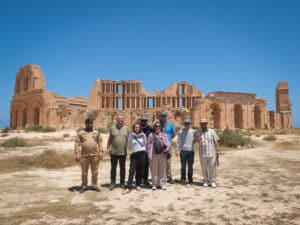
Iraq is a land where every stone holds thousands of years of history. Located in the heart of Mesopotamia, it offers travelers a unique experience, combining archaeological wonders, natural beauty, and rich cultural heritage. Here are seven things you should not miss in Iraq.
1. Touch Eternity in Ancient Babylon
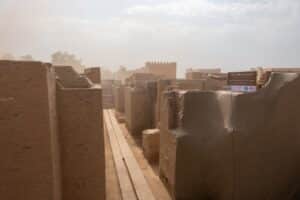
Babylon is a name that echoes through the ages. This legendary city, about 85 kilometers south of Baghdad, was once the center of a great civilization. King Hammurabi ruled here and created one of the first legal codes in history.
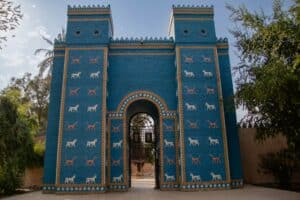
Walking through the ruins, you can see the partially reconstructed Ishtar Gate with its blue tiles decorated with dragons and bulls. The original is in Berlin, but the reconstruction gives a sense of its former glory. Walking along the Processional Way, you can imagine religious ceremonies from four thousand years ago. The ruins of Nebuchadnezzar II’s palace remind visitors of the legendary Hanging Gardens of Babylon, one of the Seven Wonders of the Ancient World.
2. Take a Boat Trip through the Mesopotamian Marshes
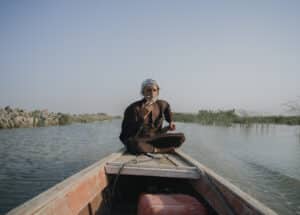
In southern Iraq, where the Tigris and Euphrates meet, lie the Mesopotamian Marshes, an ecosystem almost unchanged for thousands of years. Traveling by traditional wooden boat, called a mashhuf, through the reed-filled canals is like stepping into another world.
The marsh Arabs, known as Madan, have lived here for five thousand years, building houses on water or artificial islands. The marshes play a critical role as a stopover for migratory birds traveling from Siberia to Africa. Here, you can spot the rare Basra reed warbler and the sacred ibis. In 2016, the Mesopotamian Marshes were inscribed as a UNESCO World Heritage Site.
3. Climb the Ziggurat of Ur
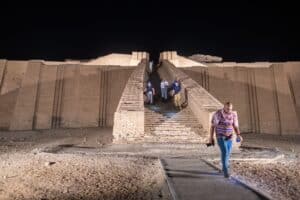
The Ziggurat of Ur is one of the best-preserved ziggurats of Mesopotamia. Built around 2100 BC by King Ur-Nammu, this temple complex was dedicated to the moon god Nanna.
Climbing the ancient steps is both a physical and spiritual experience. From the top, the view of the surrounding desert is stunning. Nearby are the ruins of the ancient city of Ur, said to be the birthplace of Abraham. Archaeological finds reveal royal tombs and treasures that are now in museums around the world.
4. Discover Iraqi Cuisine
Iraqi cuisine is a unique blend of Arab, Persian, Turkish, and Indian influences – rich, aromatic, and deeply rooted in history.
Start with masgouf, Iraq’s national dish: carp from the Tigris or Euphrates, marinated with tamarind, salt, and spices, then slow-grilled upright over an open fire for hours, giving it a distinct smoky flavor.
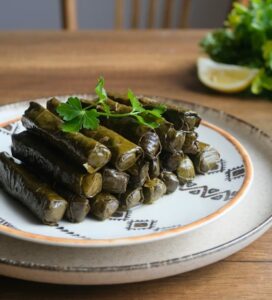
Try dolma, vegetables or grape leaves stuffed with rice, meat, and spices – in the north often enhanced with pomegranate for a subtle tang. Don’t miss kubba, bulgur filled with meat and nuts, especially the famous Mosul-style variety.
For breakfast, locals enjoy kahy with geymar — sweet flaky bread served with rich buffalo cream, often paired with strong black tea. You may also find haysa, a simple mix of dates and walnuts, and qamar ad-din, a refreshing apricot drink.
5. Conquer the Spiral Minaret of Samarra
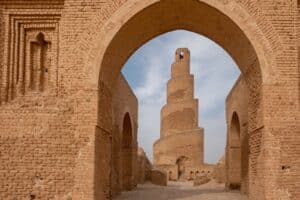
Samarra is famous for the Malwiya Minaret, a unique spiral tower built in the 9th century during the Abbasid Caliphate. Climbing the wide external ramp, which makes five full turns, is an unforgettable adventure.
From the top, you can see the ruins of the Great Mosque of Samarra and the surrounding desert. The minaret connects Islamic and ancient Mesopotamian architecture and remains a symbol of the Abbasid golden age.
6. Explore Ancient Hatra
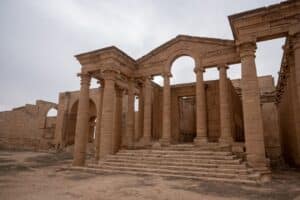
Hatra is an ancient fortified city in northern Iraq, founded in the 2nd century BC. It was the capital of the first Arab kingdom in Mesopotamia and an important religious center.
The massive temples with columns and arches combine Parthian, Hellenistic, and Roman styles. City walls are up to five meters thick. Walking through the streets, you can see homes, administrative buildings, sculptures, and reliefs of gods and rulers. Hatra is a UNESCO World Heritage Site and a remarkable testimony to ancient Arab civilization.
7. Celebrate the Kurdish New Year, Nowruz
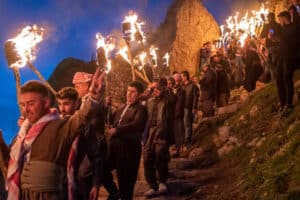
Nowruz, on March 21, marks the Kurdish New Year and the arrival of spring in Iraqi Kurdistan. In Erbil, Sulaymaniyah, and Duhok, the streets come alive with colorful costumes, flower decorations, and flags. Large fires are lit, and people jump over them to symbolically leave misfortune behind.
The festival is filled with traditional dances, especially the horani circle dance, and live music with instruments like zurna and dhol. Special dishes and sweets are prepared, and families visit relatives. Participating in Nowruz is a unique way to experience Kurdish culture and the joy of community.
Despite the challenges of recent decades, Iraq has preserved its rich heritage and renowned Mesopotamian hospitality, making a journey here a truly unforgettable adventure for those ready to discover one of the most historically significant regions on the planet.