A guide to West Africa’s most enigmatic route
Forget classic African safaris. Mauritania is where the desert makes the rules, where medieval caravan cities are slowly swallowed by sand, and where the world’s longest train carries you through the Sahara night in an open wagon. Here are seven experiences that will change how you think about travel.
1. Lose Yourself at Nouakchott’s Camel Market
Where nomadic trade has happened for centuries
Every week, hundreds of camels arrive at Nouakchott’s livestock market from across the Sahara. Some have walked for weeks. Traders from Mauritania, Mali, and Senegal converge here to buy, sell, and exchange news from villages you won’t find on any map.
What makes it special: It’s a functioning trading hub where the desert economy operates as it always has. You’ll watch traders check teeth to estimate age, run hands down legs testing for weakness. This is definitely not just a tourist attraction.

2. Sleep Under Saharan Stars at Azoueiga Dune
Where light pollution ends
Four hours south of Nouakchott, the last phone signal dies. The 80-meter dune ahead shifts several meters every year, so the sand you climb today won’t be there next season.
From the top: nothing. Genuinely nothing. No roads, no buildings, no distant lights. Temperature drops from 35°C to 15°C in two hours. At night, you’ll see 2,500-3,000 stars – versus maybe 200 in your city.
Practical note: Bring a sleeping pad – sand sleeps hard. Bring three layers, desert nights are brutal. Your Instagram photos won’t capture this, so stop trying and just look up.

3. Swim in an Impossible Oasis
Terjit: Where the Sahara has a secret
After three days of dust and 35°C heat, Terjit appears: palm trees, rock walls, pools fed by underground springs at 20-22°C year-round.
This is one of maybe 90 significant oases in a country larger than Egypt with 4.6 million people. During date season (October-November), families camp here for weeks. In March, you might have it to yourself.
That first dive, when your overheated body hits cold water – triggers an endorphin spike that feels pharmaceutical. Multiple people have called it their best swim ever, which sounds absurd until you’re the one gasping in that pool.
The springs have fed travelers for 2,000+ years. Roman pottery shards have been found nearby. You’re swimming in history that predates most European cities.

4. Stand at the Edge of the Eye of the Sahara
The Richat Structure is a perfect circle of concentric ridges, 40km across, visible from space. Astronauts use it to navigate. Geologists still argue about how it formed – impact crater (disproven), volcanic dome (maybe), erosion pattern (probably).
Age: 500-600 million years. Annual visitors: fewer than 5,000. Nearest settlement: Ouadane, 70km away across trackless desert.
Standing at the edge breaks your sense of scale. Your brain insists there must be a center you can reach. That center is 20km away. The circles just keep going, following geometry nobody designed.
Fewer people see this in person than visit Machu Picchu in a single day. Act accordingly.

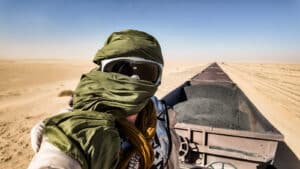
5. The Iron Ore Train: 12 Hours on Top of 18,000 Tons
The Mauritania Railway: 704km from inland mines to coast. 3-4 locomotives. 200+ wagons. 2.5km long. 16,000-18,000 tons heavy. Longest and heaviest train on Earth.
When the train arrives, and it will, eventually you climb into an open wagon and lie down on iron pellets for 12-16 hours as temperatures drop near freezing.
It’s industrial infrastructure that tolerates hitchhikers. The railway moves 11-12 million tons of ore annually, Mauritania’s economic spine.
Board wagons near the front (less dust). Bring cardboard to lie on (ore is unforgiving). Wrap a scarf around your face (dust gets everywhere). Pack water and food (no stops except rail crossings).
By morning, you have a story nobody else has.

6. Nouadhibou: Where Ships Go to Rust
Nouadhibou sits on a narrow peninsula between the Atlantic and Western Sahara—not quite Mauritanian, not quite Saharan, just odd. The coastline is lined with over 300 rusting shipwrecks, abandoned here over decades. Vessels half-sunk in shallow water, slowly decomposing into the sea.
It’s one of the world’s largest ship graveyards. Now they create apocalyptic landscapes that photographers obsess overї.
Walk the beach among dead ships. Eat fresh Atlantic fish. Let your body recover from sleeping on iron ore.
The town feels like the end of something – which makes sense, because geographically, it almost is. Desert on one side, ocean on the other, and a collection of ships that will never sail again.

7. Learn the Three-Glass Philosophy
Green tea, fresh mint, absurd amounts of sugar, brewed over charcoal, poured from height for foam. Three rounds, always three:
- First: bitter as life
- Second: sweet as love
- Third: gentle as death
Preparation takes 45 minutes minimum. You cannot rush it, that’s the entire point.
In a place where water is scarce and patience is survival, tea is how relationships form. We’ll share it with nomadic families, town elders who remember functioning caravans, guides who’ve crossed this desert their whole lives.
Some conversations happen in French or Arabic. Some don’t need words. You’ll learn more about Mauritanian culture over three glasses than any museum teaches.
Note: If you’re sensitive to sugar, warn your hosts. They’ll still make it sweet, but maybe 3 lumps instead of 8.

Ready?
We run small groups (8-12 people) because Mauritania rewards intimacy over scale. Learn more here.
Get in touch for the detailed itinerary and pricing. We’ll answer your questions.