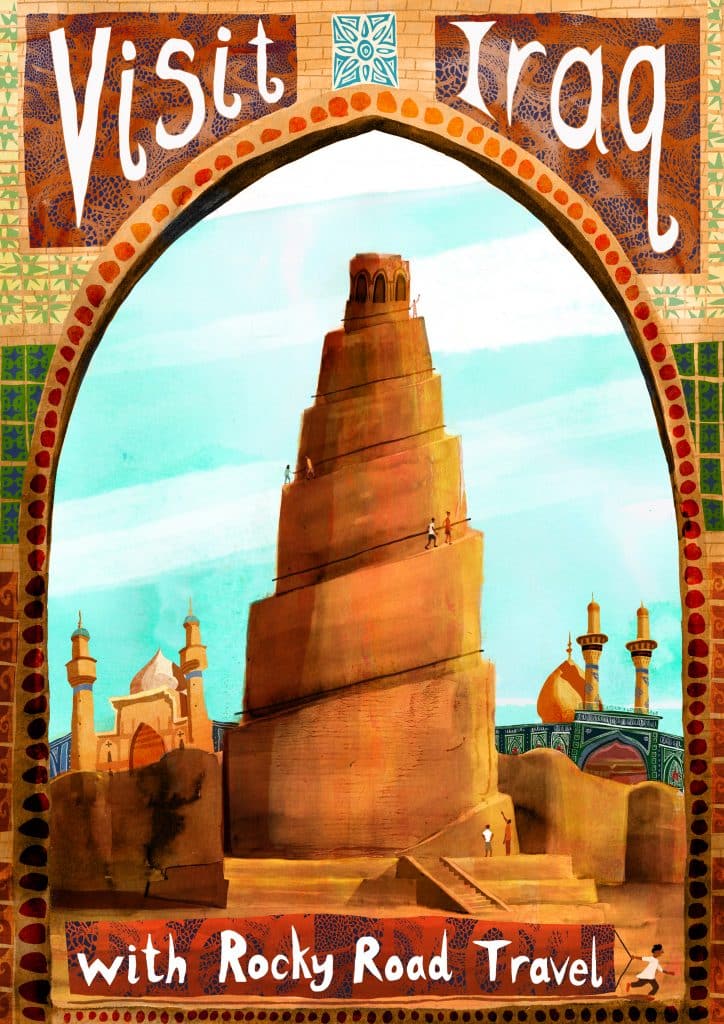
The mosque is predominantly famed for its malwiya or spiral shaped minaret. At the time of its construction in the 9th century – it was the largest mosque in the world. The towering 52 meter iconic minaret was a fitting accompaniment to the main mosque.
Originally connected to the mosque by a bridge, the minaret is characterized by a distinctive spiral conical design which rotates counter-clockwise from the bottom up. A spiral staircase leads to the top of the minaret, where an imam would recite the Muslim call to prayer.
It was the brainchild of the Abbasid caliph Al-Mutawakkil, who moved to Samarra to escape strife in Baghdad and remained there for the next 56 years—a period during which he built many palaces including the Grand Mosque of Samarra.
Samarra was the second capital of the Abbasid Caliphate after Baghdad, ruling over the provinces of the Abbasid Empire which extended from North Africa to Central Asia – it continues to be the only surviving Islamic capital which has preserved its original plan and architecture.
The name Samarra is derived from the Arabic phrase “Surra man r’a”, meaning “A joy for all those who see it”.
The mosque was eventually destroyed 400 years after its construction in 1278 by the Mongol ruler Hulagu Khan during his invasion on Iraq. Only the outer wall and minaret survived.
After extensive renovation on the mosque it was inscribed as a UNESCO World Heritage site in 2007.